Search This Blog

Follow Me on Pinterest

Friday, January 13, 2012

Efficient use of eye contact as a non-verbal teaching tool

We teachers get the opportunity to participate in workshops, seminars or training sessions to improve teaching skills on regular basis. Effective use of eye contact is part of 'classroom management' techniques which every teacher should learn.

Eye contact is a very important non-verbal teaching technique, which not only enhanced students’ attention in the classroom but also helps teachers in the attainment of desired student results.

Efficient use of eye contact in the classroom as a non verbal teaching tool:

In classroom, eye contact performs a very significant function as non-verbal communication.

Eye contact makes so much difference: if students feel that the teacher is actually talking and engaging with them, they are more likely to engage with teacher and listen what they’re saying.

Eye contact also helps to convey that all-important enthusiasm and passion that can bring the topic to life.

Teachers can use eye contact for the enhancement of learning of the students in various ways. Wainwright also highlighted six different functions of eye contact: seeking information; showing attention and interest; inviting and controlling interaction; dominating, threatening and influencing others; providing feedback during speech; and revealing attitude.

Teachers often complain about discipline, about lack of attention, about the use of L2 in the classroom and many other problems, many of which amount to a breakdown in communication between teacher and students or between students themselves. It is well known that speech is only one part of communication, yet teachers often forget about or underestimate the importance of non-verbal communication in their own and their students' performance.


One aspect of non-verbal communication is the use of the eyes to convey messages. The eyes are a powerful tool for both the teacher and the learner, yet much classroom time is spent with eyes firmly fixed on the book, the board, the floor, the window, or roaming randomly around the teaching and learning environment.

Teachers working in all disciplines in secondary schools have always been advised to develop 'the look' as part of their teaching persona. 'The look' ranges from 'be quiet please', through 'I'm not going to tell you again' to 'don't mess with me, sonny', and in this respect is seen as having a disciplinary function. Meanwhile, the business world has accepted eye contact as an important component of achieving success in giving presentations and improving rapport between representative and client, while these days it is possible to find many websites offering advice on how to forge personal relationships through the judicious use of eye contact.

Researchers and practitioners in Neuro-Linguistic Programming (NLP) have brought the notion of body language and eye contact back to the attention of language teachers, but largely in the context of providing clues to the nature of the learner rather than in terms of a teaching tool.

Establishing a management role in the classroom involves eye contact from the outset.
  • Be in your classroom before your learners, and welcome them individually with a combination of eye contact and their name as they enter the room. 
  • Talk to your learners, not to the book, the board or the screen. 
  • Eyes can set the tone of a lesson. As the lesson starts, walk around the room looking to check whether the learners are ready -- books out, pens and paper handy, mobile phones off. 
  • If not, eye contact should suffice to rectify the situation. Try teaching part of a lesson without saying anything. This should remind you of how important paralinguistics is as well as helping to control your teacher talking time.
Good eye contact does not mean staring or gazing. Many learners are likely to find this uncomfortable and consequently avert their own eyes and lose concentration. Neither does good eye contact mean eyes darting from learner to learner around the room -- this has no effect whatsoever.
  • It is recommended that there should be three to five seconds eye contact for non-verbal communication to take place. Watch your learners as well as listen to them, particularly while they are performing tasks. Look for signs of being bored or being lost. 
  • Encourage your learners to make eye contact while they are working together in pairs or groups. Start by training them to listen to each other using non-verbal responses only. 
  • Research shows that there is a strong link between the amount of eye contact people receive and their degree of participation in group communication -- in the number of turns taken in a group conversation for example.
The NLP(Neuro-Linguistic Programming) approach to eye contact is holistic and individualistic, but is soundly based on the premise that good eye contact increases rapport. Save time and effort with specific messages delivered by eye and facial expression.
Show praise, encouragement often, and disapproval occasionally.
Remind learners that they ought to know an answer or that they could provide a response if they tried.
Use eye contact as a correction technique.
Nominate and invite responses by eye. If the nominee is not watching, someone will give him/her a nudge.

Eye contact is, fundamentally, time and effort saving. Teachers can use their body movements, eye contact, facial expressions; smile; anger; frown, pitch of voice, and spatial distance for better understanding of the concepts of students. In the classroom setting eye contact of the teacher, as non-verbal cue, is very vital and directly affects the learning of the students in addition to the classroom management. Eye contact is a tool of teaching, which a teacher can use very efficiently and effectively for the enhancement and achievement of students’ learning outcomes (SLOs) 

More reading and useful links:

* Eye contact as an efficient non verbal teaching technique

 * Eyes Talk Hongshen ZHANG Fujian University of Technology

 * The Importance of Eye Contact in the Classroom

* Non verbal communication (An article at 'Teaching English-BBC)

* Body Language- Speaking without words

Wednesday, January 11, 2012

Making crafts with paper strips and newspaper

Paper is easily available product which can be used in variety of ways. You can encourage and help kids in creating crafts with newspaper or paper strips. Usually I keep a stock of colorful paper strips. At crafts class kids love to touch and feel paper strips and they love to create shapes or different objects. This article offers few tips and ideas how you can keep your kids busy with these paper crafts or sculptures.

Newspaper can be used to create crafts and paper sculptures.  “Newspaper sculpture” is a way for kids to create an art piece with tightly rolled-up pieces of newspaper. 


With a “newspaper sculpture,” children will use their hand-eye coordination. Encourage them to make their own sculpture. 
Before you begin the activity, prepare by having several wands of tightly rolled newspaper pre-made. This way, the children can dive right into the activity. Place the wands of newspaper rolls standing up (like a flower arrangement) in a bucket or container so they are easy for the children to grab. Lay out lots of rolls of masking tape of different colors.


 Bring the kids over to your activity area and let the kids start creating their own sculptures. Encourage them to bend the wands of newspaper into different shapes. Have them use the masking tape to help retain the shape of their sculpture and to tape together different pieces of newspaper rolls. You may offer idea of making a weaving mat using newspaper wands.
Learn more at: 'A place of our own.org'


Children love to use the paper strips.   Many objects, figures, shapes or 3D shapes, or mobiles can be made by just tying strings to them. This is a great way to teach children about 3 dimensional figures and space…. not to mention teaching them their basic shapes.


Just show them a few examples of figures or shapes and kids would come up with more ideas. 

Stars and Stripes or Shape Sculptures:   Cut different size strips of red, yellow and blue paper.
Fold some strips into circles, some into squares others into triangles. Cut out large shapes for a base. Arrange shapes and strips on your base and glue into place. 


Cut free-form shapes of varying sizes from colored card stock or scrapbook paper (ours measure 3 to 5 inches wide and 3 to 8 inches long). Snip two to four 1-inch slits into the sides of each shape. Build a sculpture by interlocking the pieces along the slits. 


 Useful links: 
 * Paper Flowers – Anyone Can Do That 
* Recycled Paper Weaving in Grade Two 
* Art Lessons For Kids 
* Summer Crafts For Kids: Sculpting With Paper Strips

Tuesday, January 10, 2012

Role of classroom decor in classroom management


There are many elements of classroom decor that can affect a student’s ability to learn. Colors in a classroom can make you more receptive to be in the mood to study or learn. Classroom decor plays an important role in class management.

A mural at Play class wall- showing Islamic culture and nature
Simple and organized decorated classrooms enhance calm learning environments. Children are attracted to bright colors, but use the bold palette sparingly. Guide students’ attention to specific points you want them to retain, and use the bright colors there instead of anchoring the room in bold yellows or reds.

 A preschool classroom is a lively and energetic place. Preschool children are naturally curious and creative, so the decor of this classroom should showcase their creativity and challenge their curiosity. Make sure that the decor is colorful and placed at a level that makes it possible for small people to see and appreciate it.

You can notice the decor of play class in our school. Hanging paper plates are in various colors with numbers. Other resources and decoration around this classroom corner fulfill the purpose of interactive learning.

The artwork or posters on display on the classroom walls encourage learning and creativity, or act as a distraction. Most teachers carefully select this part of the décor and usually try to play towards their students’ imagination. Students need to feel comfortable with a nice balance of decor they can relate to. Students enjoy seeing their papers hung up around the room, reminding them of their other good grades.

The biggest focal point in the classroom is the bulletin board and it should be the backdrop for your room’s theme. Educational supply stores carry many popular theme kits, everything needed for decorating a classroom - borders, posters, bulletin board content and suggestions for fun classroom activities, but don’t go overboard with the decorations. Strike a balance between the décor, the color scheme and the educational information. 

Useful links and resources:

What You See Is What You Get In The Classroom

*  Classroom Decor Themes and Tips DIY Classroom Decorations

 * Classroom decoration themes and ideas

* Classroom decoration ideas

* Creating a cozy classroom

Sunday, January 8, 2012

Crafts and origami learning with kids

It is fun to teach crafts and origami to kids ( at early years).  I teach easy origami to kids in my Nursery class. I believe that origami helps in development of fine 'motor skills', intellectual abilities and creative abilities. As kids in our Nursery class are from the age group of 4 to 5 plus, even easy origami projects are sometimes difficult to follow, and kids need help at later steps for completing these tasks.

As you can notice from facing picture that I have mixed the drawing and origami together to make an interesting crafts.

As the outcome of this crafts was amazing, we selected it as a folder cover which we hand over to parents at 'Parents teachers meeting' as a record of kids learning.

How this crafts project was created?

1- First I teach them to make a simple house.
2- In second art/crafts class I told them to make a tree.
3- Third stage was to fix both origami projects at art book and finish it by drawing clods, grass, flower etc.
4- We fixed some pencil carving at the roof of the house to make it more attractive and appealing.

Friday, January 6, 2012

Early year display boards

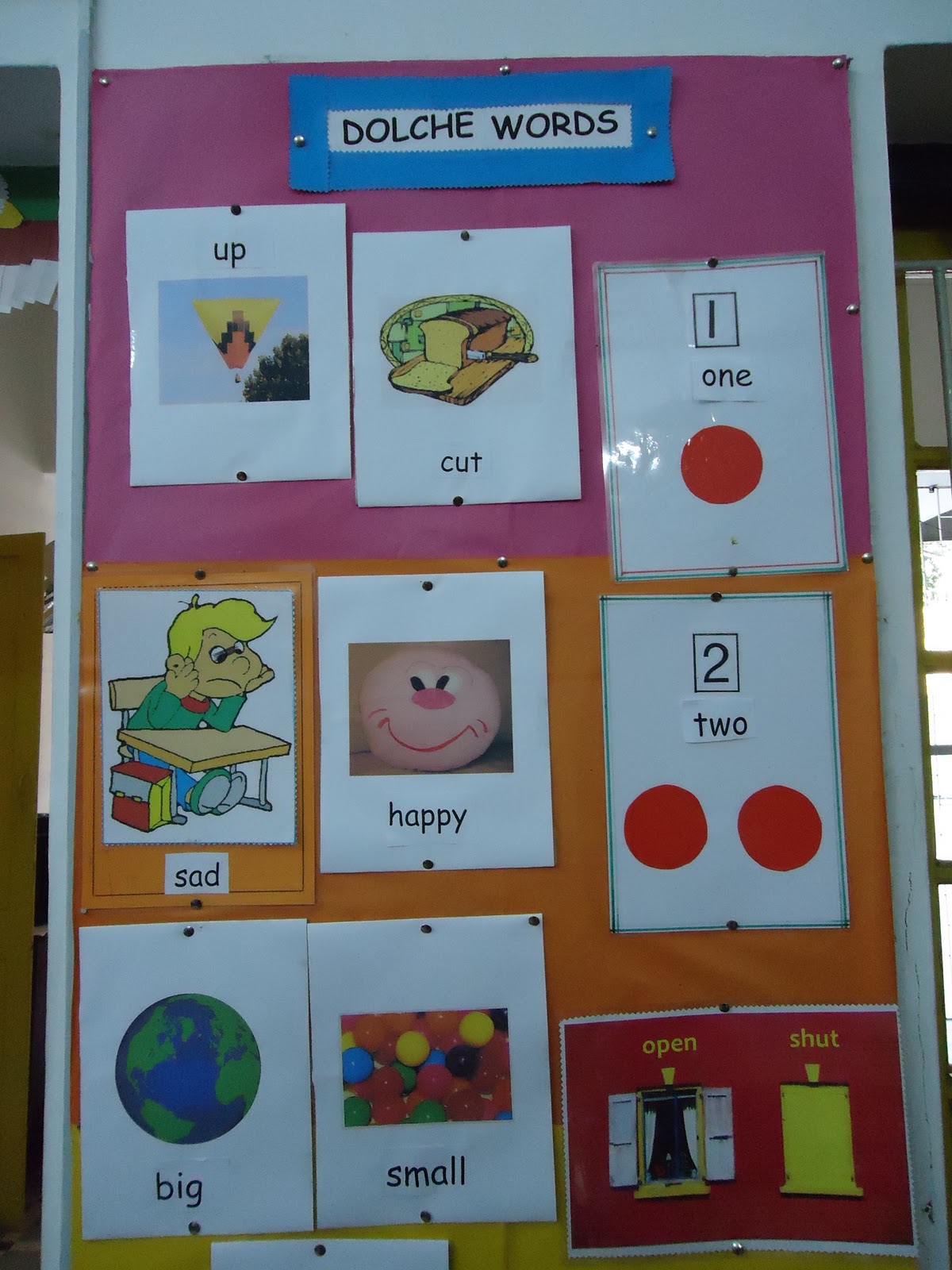
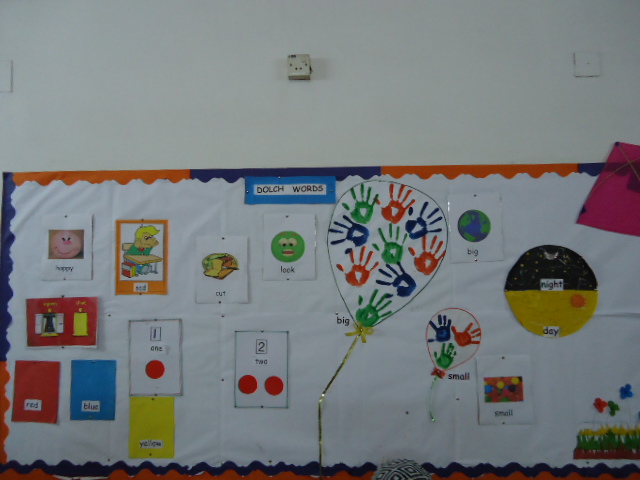
In reception years, we teachers decorate our bulletin boards for display at the occasion of parent teacher meeting. Parent teacher meeting is held after every two months in a year. As we have completed our first term (Whole year is divided into two terms), our bulletin boards were showing the process of learning.

In our play class English board was showing 'Dolche Words':


These colorful display boards are used as a helping tool for learning. 

Saturday, August 6, 2011

Why We Need to Appreciate Our Teachers and Celebrate Appreciation Day?

There are events and celebrations for every relation like fathers day, mothers, friendship day and occasion like birthdays or ceremonies etc.
How about celebrating teachers appreciation day and week?
and why we need to appreciate our teaches and celebrate appreciation day or week?

Teachers play a key role in every individual’s development and evolution. Showing appreciation to them is a fair reward and an act of gratitude that will also make you feel better. Teachers are that special part of the community helping us all to grow up and be better citizens. This is why most countries celebrate either the World Teachers’ Day (WTD) or their own national equivalents.

Schedule for teachers day and week:

Teacher Appreciation Day 2010 – May 4th

Teacher Appreciation Week 2011: 2nd – 6th May

UNESCO inaugurated October 5 as World Teachers Day, although in the USA, Teacher Appreciation Week is typically celebrated on the above May dates.

Teacher appreciation day 2011 is near and you should be thinking of the ways you can put a smile on your teacher’s cheek. Actually, there are millions ways you can do this, and it will always matter on how you offer this things than what you can offer.

Teachers will always be happy—no matter what you will have to give them.

Other times to honor our teachers is at the end of the school year, thanking them for all they’ve done for our children, at the holidays with a gift, on their birthdays or anytime you feel like thanking a teacher for his/her hard work. Teachers will appreciate all your efforts at any time of the year! Expressing your gratitude for all they do will is especially meaningful during Teacher Appreciation Week and on Teacher Appreciation Day each year.A week, and a day is not enough to thank your teacher for teaching your over 9 months. But you can always make very activity worth remembering if you present it with honest desires and the will to offer gratitude.

Traditionally we remember to show our appreciation for our child’s teacher either during "Teacher Appreciation Week" (in the US) or at the end of the school year. But there is nothing to stop you letting your teachers know how much you appreciate them at any time of the year!

Why we need to appreciate our teacher?

Teachers are one of the most important adults in a child’s life - and yet for much of the time we take them for granted. A dedicated teacher is one of the world’s most precious resources. Our children spend many hours a day with their teachers, who help mold them, shape their character and teach them academic subjects they need to survive in this world, plus they play mediator in many life lessons our kids face when we’re not there to help or untangle the complications of interacting with their peers.

If your child has the great fortune of having one of the really good teachers in our world, by all means, show your appreciation for their dedication and mostly thankless jobs. These special teachers deserve our respect and appreciation and reinforcing their good work will inspire them to continue in their profession, inspire other teachers and generally keep the tradition of inspiring teachers alive.


Sources: Teacher appreciation
- Rexanne

Useful links:
* Annie’s "National Teacher Day" Page


First published at 'factoidz'

Wednesday, August 3, 2011

How to Amuse Your Guests with Toilegami?

Toilegami’ is actualy is the origami-style folding of toilet paper.
Toilet paper origami is also called Hotel Toilet Paper folding as it is practiced in many hotels worldwide. You can also amuse and great your guests with this amazing origami style. This post offers enough online resources about basic toilet origami folds. Learn some basic and interesting facts about toilegami and start folding toilet paper to have fun.

Basically, the cleaning staff folds the first piece of toilet paper on the roll into a shape. The most popular is the triangle fold, and it’s a great way to greet your guests when they visit your bathroom.

Knowing a few simple techniques can entertain your guests and confuse family and friends when you visit.

How this origami style was created?

It is called origami style because it is an art form which is amusing and entertaining. The purpse or origin of this origami style is unknown but there are two basic reasons of this creative art:

As a way of assuring guests that the bathroom has been cleaned.
To impress or delight guests with the management’s creativity and attention to detail.
There are two ways to do toilegami:

- fold the toilet paper while it is still on the roll, or

- fold a single sheet of toilet paper.

The common fold normally involves creating a triangle or "V" shape out of the first sheet or square on a toilet paper roll. Commonly, the two corners of the final sheet are tucked behind the paper symmetrically, forming a point at the end of the roll. More elaborate folding results in shapes like fans, sailboats, and even flowers.

Few easy to learn toilegami folds are:

The Triangle Fold,
The Diamond Fold
The Pleated Fold,
The Pleated Tuck Fold
The Flourish
You can learn these folds from ‘Origami Resource Center’

Toilet paper folding or toilegami has attracted the attention of observers within the hotel industry and beyond it, involving both sober discussion of the practice as a marketing move as well as wry commentary with various degrees of seriousness. The practice has been considered an emblematic example of a meme copied across the world from a hotel to another until the point that most of them now do it.

Interesting facts:

Stephen Gill, a British photographer has published a book of pictures of folded hotel toilet paper from various nations.
Hotel toilet paper folding is such an institution that in the horror movie 1408 it is used as one of the eerie happenings noticed by the main character—after using the toilet paper, he finds it mysteriously has been freshly folded over.
The Tickle Pink Inn, a motel in Carmel Highlands, California, folds the ends of its toilet paper into fan-like designs, mirroring the folds of its bathroom washcloths.
One travel writer noted seeing toilet paper folded into flowers and sailboats at hotels in Costa Rica.
An automated toilet paper folding machine called Meruboa was invented in Japan. With the push of a lever the device folds the first sheet of toilet paper into a triangle.

Interesting links and online resources:
* Stephen Gill explains why he spent three years taking pictures of hotel toilet paper. The loo roll that says I love you
* Toilet paper origami pictures from many hotles around the world
* A blog ‘Toilet Paper Origami’ (Most pictures or this article are taken from the same blog)
* Learn two basic folds of toilegami from thissimple tutorial
* How to: Make Toilet Paper Origami

First published at 'factoidz'

Tuesday, August 2, 2011

What is Pygmalion Effect and How Teachers Can Use It to Achieve Better Performance Among Students?

We know that more positive you are in your approach towards your career or teaching, more successful and a better teacher you are. So having believe in what you are doing reflects in your behaviour and your dealing with students. Having faith that your students are cabable of doing better brings positive results and it is the term called ‘The Pygmalion effects’.

According to the definition by wikipedia: The Pygmalion effect, or Rosenthal effect, refers to the phenomenon in which the greater the expectation placed upon people, often children or students and employees, the better they perform. The effect is named after Pygmalion, a Cypriot sculptor in a narrative by Ovid in Greek mythology, who fell in love with a female statue he had carved out of ivory.

Robert Rosenthal and Lenore Jacobson (1968/1992) report and discuss the Pygmalion effect at length. In their study, they showed that if teachers were led to expect enhanced performance from some children, then the children did indeed show that enhancement.

Research clearly depicts that teacher expectations can have both positive and negative effects on student learning and achievement. Ormrod (1999) insists that expectations influence the ways in which teachers evaluate students, behave toward students, and make decisions about students.

When teachers expect students to do well and show intellectual growth, they do; when teachers do not have such expectations, performance and growth are not so encouraged and may in fact be discouraged in a variety of ways. In the famous Oak School experiment, teachers were led to believe that certain students selected at random were likely to be showing signs of a spurt in intellectual growth and development. At the end of the year, the students of whom the teachers had these expectations showed significantly greater gains in intellectual growth than did those in the control group. This was especially pronounced in first and second graders and in fifth and sixth graders, though less so in third and fourth grade students

James Rhem, executive editor for the online National Teaching and Learning Forum, commented:

"When teachers expect students to do well and show intellectual growth, they do; when teachers do not have such expectations, performance and growth are not so encouraged and may in fact be discouraged in a variety of ways."

Praising your child results in that your child will believe that they are intelligent, it will become part of who they believe they are and they will act accordingly and you will find that this belief has a positive impact on those areas of your child’s school work that they may not doing as well as they could be.

Your child’s belief that they are intelligent will raise their performance in all areas of school life as they act on that belief. Not only teachers but parents can use it achieve better performance in all phases of life.

Useful links:

The Pygmalion Effect: A Dramatic Study in the Classroom
Pygmalion In The Classroom

First published at 'Factoidz'

Tuesday, June 28, 2011

How to learn and draw mind map?

Mind maps are very useful for visualising and structuring ideas, brain storming, studying and much more. Mind maps are a way of organizing your thoughts. This post helps you to learn what is mind mapping and how to learn to draw it? Online resources and links which I use in my articles are free to use and you can learn it without any cost.

What is a mind map?

Mind maps are, by definition, a graphical method of taking notes. Their visual basis helps one to distinguish words or ideas, often with colors and symbols.

A mind map is a diagram used to represent words,ideas, tasks, or other items linked to and arranged around a central key word or idea. Mind maps are used to generate, visualize, structure, and classifyideas, and as an aid to studying and organizinginformation, solving problems, making decisions, and writing.

A mind map is an awesome visual tool that can help you to:

  • clarify your ideas                                                      
  • define your goals
  • spark your creativity
  • renew your sense of purpose
  • rejuvenate your zest for life

To make the learning process easier and more fun, you can use the mind map tool to make a map of your thoughts and sort them thematically.

Uses of mind maps:

One of most popular mind map uses is to create a mind map about your goals. This allows you to articulate your goals, put them down on paper, and see how they are interconnected. You can mind map about immediate goals (such as daily tasks or an elaborate to-do list) or mind map about long-term goals that extend far into the future.

When you're done, you will have a beautiful mind map that you can hang on your wall in your studio or in your workplace, tape inside your sketchbook, or place anywhere that will allow you to see it every day. By visualizing your goals, you can help center your energy and focus your intentions on what you want to do or achieve.

How to create a mind map in easy way?

Mind maps use words, colors and images to convey meaning. Typically, mind maps start in the center with the main theme and emanate outwards. Thoughts and ideas branch outwards from the central point.

Learn how to create a mind map with the help of step by step instructions:

* Create a mind map

* 'Draw anywhere' is an online tool to create diagrams online for free.
* 'Simple Mapper' is another similar site with ideas to

* Text 2 Mind Map is a web application that converts texts to mind maps.
It takes a structured list of words or sentences, interprets it,
and draws a mind map out of them.

* 'Think' is a free mind mapping tool which helps you to create, change and view mind maps.

Saturday, June 4, 2011

How habit of reading books enhance your life skills?

Did you know that reading can keep your mind active and engaged well into old age?
Habit of reading books not only keeps your mind busy but it enhance your life skills in many ways. Read the benefits of reading books and decide yourself if it makes your life better or not?

Developing good reading skills means that you can think for yourself. That you can read about the advantages and disadvantages of anything from breast feeding to homeschooling to taking a vacation to Ireland. And then you make up your own mind about what's best for you and your family.

More benefits of reading books:

  • When reading a book you gain not only knowledge but you share another person's view of the world.
  • A book can comfort and console and be returned to again and again, like meeting an old friend.
  • A book can grow with you. When you re-read it as your life develops, you will gain more and different insights into the work.
  • Reading reduces stress
  • It can be a thing of beauty.
  • It feeds your spirit.
  • It keeps your brain in shape. Similar to solve puzzles, reading books allows your mind to practice his skills of treatment.
  • Develop your critical thinking skills: One of the main benefits of reading books is its ability to develop your critical thinking skills.
  • It makes you more eloquent: Nothing is quite as reading books for you help become a better conversationalist.
  • It is available: One of the great benefits of reading books is that the information that it can be viewed again and again.
You can buy books, hire from nearest library, browse through net or read ebooks, or simply hire from offline or online sources like 'booksfree'


Useful links:

The Benefits of Reading

* 8 Benefits of Reading

* The 26 Major Advantages to Reading More Books

Friday, March 25, 2011

Why we need to adopt energy saving habits by recycling and reducing?

At the occasion of 'Earth Hour Day' I want to share some facts with you. By reusing, reducing and recycling we can save energy and help save our planet earth. Why we need to re-use, reduce or recycle can be understood by having a glance at these facts. This fact sheet is enough to alarm us, why we need to adopt habits of saving energy by recycling, reducing and reusing.

  • The garbage in a landfill stays for a for about 30 years.
  • In 1995 over 200 of the world landfills were full.
  • Each person throws away approximately four pounds of garbage every day.
  • One bus carries as many people as 40 cars!
  • More than 1/3 of all energy is used by people at home
  • Most families throw away about 88 pounds of plastic every year
  • We each use about 12,000 gallons of water every year
  • 1/3 of all water is used to flush the toilet.

One hour of darkness can help the world see the light

"One hour of darkness can help the world see the light (awarenss on climate change)
This one hour or 60 minutes are called 'earth hour'

The Earth Hour 2011 is March 26, Saturday from 8.30 to 9.30pm and during this hour lights will switch off around the globe.

Earth Hour is a global event organized by WWF (World Wide Fund for Nature, also known as World Wildlife Fund) and is held on the last Saturday of March annually, asking households and businesses to turn off their non-essential lights and other electrical appliances for one hour to raise awareness towards the need to take action on climate change.

So far this is the largest environmental campaign in the history of our planet.

A record 131 countries and territories are registered to take part in Earth Hour this Saturday at 8:30 local time, and many global organizations will join the hundreds of millions that are expected to take part.

Earth Hour began in Sydney, Australia in 2007 as a one-city environmental campaign and has grown into a grassroots initiative with participants across the globe. Ann Arbor joined the effort in 2008 as one of 371 cities in 35 countries to participate in Earth Hour.                      

Purpose of Earth Hour:

The principal of Earth Hour is that small actions taken by a large number of individuals can have a large impact on greenhouse gas emissions. If these actions can be backed by larger scale government actions, the impact could be tremendous.

For example, standby power on televisions, microwave ovens and the like causes 1 percent of global greenhouse gas emissions according to the UK Government's chief scientific adviser Sir David King.

Speaking in Sydney, Sir David said:

"We have become so prolific in our use of energy that it is going to be relatively easy for us to reduce energy usage, save money and reduce emissions."

"People talk about what tackling climate change would do to your GDP growth but if you grab all of the low-hanging fruit that is available on energy efficiency you are going to manage that at no cost. In fact, it is a cost saving."


Studies carried out by Earth Hour organizers WWF show energy efficiency represents between 35 and 40 percent of the solution. The studies show that improving the levels of insulation in houses is by far the cheapest way to cut greenhouse gas emissions.

“It is only through the collective action of business, organizations, individuals, communities and governments that we will be able to affect change on the scale required to address the environmental challenges we face,” said Andy Ridley, Co-Founder and Executive Director of Earth Hour.

“Climate change is the greatest human induced crisis facing our world today. It is totally indiscriminate of race, culture, class, nationality or religious belief. It affects every living organism on the planet – including all of us,” Archbishop Emeritus Tutu said.

“Through the symbolic act of switching off our lights for one hour on Saturday 26 March from 8.30 – 9.30pm we will collectively send our clarion call for change around the globe. ‘Please, political leaders and captains of industry, we implore you. Take action against climate change NOW.’”

Hundreds of millions of people in 133 countries and territories across the globe are expected to switch off their lights at 8:30pm local time tomorrow, Saturday 26 March.
In a series of video messages posted to YouTube, world leaders have pledged their support for the world’s largest voluntary environmental action.

Useful links:
* Earth Hour.org

Sunday, March 13, 2011

Celebration of Go Green events

As the world population is growing, our natural resources are insufficient to provide us sources of energy for our future generations.  We need to raise awareness about energy crisis by recycling and going green.

What is Go Green?
 'Go Green' is a campaign about environmental issues that affect the future of the planet. "Going green" is a term used to describe "being more environmentally conscious in all aspects of your life".

The goal of "going green" is to practice behaviors that help reduce your overall carbon footprint, which is a measurement of all greenhouse gases we individually produce.

Our School proudly hosted an event to raise the awareness about 'Energy Crisis'and called it 'Go Green 2011'. Purpose of 'Green Deen Day' was to successfully implement the Go Green Initiative and create meaningful environmental change at school, among parents and society. Plus realize our responsibilities as Muslims to be protectors and caretakers of our environment.

March 12, 2011 was named 'Green Deen Day' to celebrate the 'Go Green 2011' event. The event started a month ago involving the school children and teachers to work together for making and creating projects, posters, slides related to the topic.

Why Green Deen Day?

A "Green Deen" is the choice to practice your religion while affirming the synergies between faith and the environment.
Environmentalism fits into the goals and ethics of Islam. There is ample evidence in the Quran - over 700 verses that relate humans to their environment.
The Prophet Muhammad was reported to care for all the creation of God. The Qur'an quotes that he was sent only as a mercy to all the universe (not just mankind)

Islamic teachings provide an ethical worldview of Nature and extends an invitation to believers and non-believers alike to reflect on natural phenomena, and to safeguard natural elements as an invaluable trust so that they may avoid disturbing the inherent balanced state of the planet

Slogan of the Green Deen Day (held on March 12, 2011) was 'Reuse the past, recycle the present, save the future'

Students displayed energy crisis related projects, along with recycling projects, posters.
Topics were:


Energy conservation
• Use less electricity
• Leads to reduced emission of harmful substances
• Leads to availability of electricity for other people

Renewable Energy Sources
• Solar, Wind
• Water, Wave

Stalls of every class were packed with recycled products or energy saving related projects. Early year  students of class KG 2 prepared a small demonstration in favor of 'Go Green' which was well appreciated by audience.

The whole program ( for female visitors and girls participants ) was held from 8.30am to 11.00 am and  same program was repeated for male students and visitors from 11.00am to 2.30 pm (Including a break for Zuhur Salah)

Visitors were guided by the volunteer students around the school to make the events organized and on time. Announcement and stage organization was also done by students (co-ordinated by teachers)

Every class was distributed in two groups and there were competitions among them. A voting system was organized and students, teachers and visitors were encouraged to vote the teams with better projects and better communication skills.

The gifts for winning teams were distributed at the end of program
The gifts were 'Go Green' related (small varieties of cactus plants for every winning team)

A promise mat was placed at the end of stalls. Visitors were asked to write their promises to change their lifestyles and help improve environment. Interesting thing about this promise mat was that like all the projects, it was also made of used paper. (recycled)
  • Ordinary people can positively impact our world in their everyday lives.
  • Through simple, responsible behavior shifts, together we can protect human health through environmental stewardship.                                     
Useful links:

* Why Go Green from Go Green Initiative.org

* 'NOAA This portal is designed for educators to accessing materials related to environment issues.

* Shout learning resources and tools

* Earth Echo International EarthEcho International's mission is to empower youth to take action that restores and protects our water planet.

* How we can go green? 'Treehugger' offers many useful posts

A collage of our awesome event:
Posted by Picasa

Tuesday, March 8, 2011

What Islam teaches Muslims about protecting the planet and environment?

Nowadays we are using another term 'Green Deen' which represents the relation of Islam and environmental issues. Islam teaches Muslims about environment and protecting the planet in many ways. Informed Muslim can easily speak on Islam and the environment for a number of reasons.

First of all, Islam is described in the Qur'an as the religion of nature. Allah declares:

"Therefore, orient yourself, with all due sincerity and uprightness towards the natural religion; this is consistent with the nature He (God) has created in humankind. Never will there be any change in that nature, this is the straight way. However, most of humanity realizes it not." (Qur'an 30:30)

Having created us, and then through the institution of religion oriented us towards Him, our Creator then situated us in a delicate, intricate system where our success, and indeed the perpetuation of that system, rests in maintaining a balance between all things. He says in the Qur'an:

"The Merciful. He has taught the Qur'an. He has created the human being. He has taught him elocution. The sun and moon flow along in their established orbits. The stars and trees recline themselves humbly in prostration. He has raised aloft the firmament of the sky and established the balance. Therefore, cheat not in maintaining the balance. Establish just measure and do not fall short in maintaining the balance." (Qur'an 55:1-9)

In this group of verses, Allah enumerates some of His Blessings to humanity. He starts by mentioning the Majestic Qur'an. As Muslims, we believe that the Qur'an contains the enduring message of God to humanity. Its guidance defines the worldview of the conscientious believer.

God reminds us: "Remember the blessing of God upon you, and the Scripture and Wisdom that He has revealed unto you, by way of admonition. Be mindful of God, and be assured that He knows all things." (Qur'an 2:231)

In Islam, Muslims believe that man has been given a responsibility by Allah (i.e., Arabic for God) on this earth and that man will be accountable to God for his actions and the trust placed in him. Prophet Muhammad said, ”Everyone of you is a guardian and is responsible for his charges. The ruler who has authority over people is a guardian and is responsible for them” (Sahih Bukhari 3.46.730). Islam has urged humanity to be kind to nature and not to abuse the trust that has been placed on the shoulders of man.

Nature and environment have always played an important part in the lives of devout Muslims. Muslims understand that God has not created all this for nothing. In fact, Muslims have been commanded to find the wonderful signs of God around them so that they will only increase them in their awe of their Rabb (Cherisher and Sustainer).

Author Ibrahim Abdul-Matin's Green Deen: What Islam Teaches About Protecting the Planet, has presented to Muslims and anyone interested in what Islam has to say about the environment what a green deen is.

He starts the book by defining the word Deen not as a religion, but as a "way of life" in Arabic, a system of living and interpreting the world as a way to arrive at peace with it. Add the color green to it, and Green Deen was written as a practical approach to merge personal faith with the common cause of environmentalism:

"Green Deen means understanding that God created us directly from the Earth and that we must do all that we can to take care of it, protect it, and manage all of its bounty in a sustainable way."

From his perspective, everyone, Muslim and non-Muslim alike, can create a green Deen because everyone can contribute to how we take care of the Earth in our public and private lives.

It is unfortunate that Muslims forget this, do not care to recycle or at least use less, and actually contribute to the degradation of our planet. It doesn’t matter your faith to be a greener person, but Muslims should step up to the plate.

Useful links for more information:

* Going Green For The Deen at 'Muslim Youth for Truth' blog'
* AN ISLAMIC PERSPECTIVE OF ENVIRONMENTAL ETHICS
* Environment & Ecology in Islam
* Environmental Responsibility Clear in Islamic Scriptures
* Man and Ecology: An Islamic Perspective
* Islam and the Protection of the Environment

Wednesday, March 2, 2011

What happens when your kids Spend too much time in Front of Computer?

If your kids spend 2 or more than two hours at a computer every day, then they are at greatest risk for developing "Computer Vision Syndrome"(CVS). According to the National Institute of Occupational Safety and Health, computer vision syndrome affects some 90% of the people who spend three hours or more at day at a computer.

In this day and age, where students and working adults spend hours and hours on end in front of the computer screen, CVS is more common than you think. It has been said that people who spend more than a mere two hours on a computer each day tend to suffer from this ailment.

Statistics show that, in general, such eye and vision problems afflict some 70 to 75 percent of people with desk-bound jobs who work in front of the computer. This makes CVS the most frequently reported health problem among these computer workers.

But how to know that you are having the Computer Vision Syndrome CVS?

Read more at:What happens when your kids Spend too much time in Front of Computer?

Wednesday, February 23, 2011

How to Know if Your Child Has Any Learning Disability and Deal with It?

When children have learning problems, their parents are usually the first to notice that something is just not right. Teachers often notice a child having trouble in their class. This post helps you learn about ‘learning disability’, early and warning signs, and as usual bottom of the page has resources section. I hope that earlier you notice any learning disability sign among a child, it is easier to deal with it as a parent or teacher.

"A learning disability is a neurological disorder. In simple terms, a learning disability results from a difference in the way a person’s brain is "wired." Children with learning disabilities are as smart or smarter than their peers. But they may have difficulty reading, writing, spelling, reasoning, recalling and/or organizing information if left to figure things out by themselves or if taught in conventional ways."

Common learning disabilities include Dyslexia, Dysculculia, Dysgraphia, Auditory and Visual Processing Disorders, and Nonverbal Learning Disabilities etc.


Read more: How to Know if Your Child Has Any Learning Disability and Deal with It?

Saturday, February 19, 2011

Importance of Recycling

Recycling not only helps us saving energy, water and resources it also reduces pollution and thus saves our environment. It is one of the most feel-good and useful environmental practices around. It also cuts global warming pollution from manufacturing, land filling and incinerating. Recycling benefits our environment in many ways. The benefits go way beyond reducing piles of garbage — recycling protects habitat and biodiversity, and saves energy, water, and resources such as trees and metal ores.

What is recycling?

According to ‘wikipedia’ : Recycling involves processing used materials (waste) into new products to prevent waste of potentially useful materials, reduce the consumption of fresh raw materials, reduce energy usage, reduce air pollution (from incineration) and water pollution (from landfilling) by reducing the need for "conventional" waste disposal, and lower greenhouse gas emissions as compared to virgin production.

Read some facts which can help us understand why recycling is so important for our environment:

Read more at: Importance of Recycling for Saving Our Environment, Energy, Water and Resources

Thursday, November 25, 2010

Role of nutrition bringing positive change in child behavior

There is a direct link with right food choices and child behaviour. Normally we can notice that when a child is not properly nourished, he/she cannot perform well in physical or mental tasks at school or home. Nutrition play an important role in not only physical or mental growth of a child but in child’s behaviour as well. This post  provides facts and statistics proving that nutrition can help bring positive change regarding child behavior.


Experts have discovered that food can ramp-up children’s behavior. Now recent research and studies have proved that foods and ingredients can, indeed, make a difference. It makes perfect sense that what kids eat affects their behavior. It is well established that poor nutritional intake and deficiencies in zinc, iron, B vitamins and protein can impair brain function and lead to violence and antisocial behavior in children. Nutritional deficiencies, including zinc, magnesium, calcium and essential fatty acids, as well as carbohydrate cravings, have also been noted in children with attention deficit/hyperactivity disorder (AD/HD).
Nutritional supplements may be helpful in deterring violent and anti-social behavior. When vitamin and minerals were given to elementary school children with behavioral problems, it led to a reduction in the incidence of anti-social behavior.
The researchers said that "undiagnosed and untreated malnutrition may be impairing their brain function to such an extent that normal learning from discipline does not occur."
Malnutrition in the first few years of life leads to antisocial and aggressive behavior throughout childhood and late adolescence, according to a new USC study.
“These are the first findings to show that malnutrition in the early postnatal years is associated with behavior problems through age 17,” said Jianghong Liu, a postdoctoral fellow with USC’s Social Science Research Institute and the lead author of the study published in the American Journal of Psychiatry’s November issue.


How we can make healthy change in food habits?
By:

• minimizing exposure to junk food and food additives, 
• choosing nourishing, primary, low allergenic foods as dietary staples, 

• assuring nutrient adequacy by careful monitoring of the child’s food intake. 


Supplemental Diets 
It stands to reason that an adequate diet is necessary for a child’s healthy growth. Proper nutrition, including an array of vitamins, minerals, amino acids, and essential fatty acids (EFAs), is particularly necessary in the first few years of life to support brain development and prevent certain neurological disorders. Even among older children, a lack of certain dietary components such as protein, or an insufficient number of calories, can negatively affect a child’s learning and behavioral abilities, and vitamin or mineral deficiencies can certainly interfere with learning over the course of a school year.
Research shows, however, that a young child must be significantly malnourished in proteins and calories before brain development is seriously affected, and this level of malnutrition is rare in the United States. To date no convincing evidence has shown that a poor diet causes ADHD, or that dietary supplements can be used to successfully treat the condition.


First published at 'factoidz'

Useful links:
 * Your Child’s Diet: A Cause and a Cure of ADHD? 

Wednesday, November 24, 2010

What are the essential foods for kids to stay healthy?

Getting the necessary nutrients is necessary for long-term health. Having basic information about the recommended daily allowance (RDA) for your children — and what they shouldn't eat regularly — can establish healthy habits to last a lifetime.

Essential Foods for Kids: Jatinder Bhatia, MBBS, professor and chief of the section of neonatology at the Department of Pediatrics at the Medical College of Georgia, says children's daily caloric intake, which provides them energy, "should be balanced between carbohydrates and protein, with the remaining energy coming from good fats." Children also need iron, vitamin D, calcium, and fiber, but these four tend to be lacking in youngsters' diets, he says.

Iron, Vitamin D, Calcium, and Fiber

Here is some guidance on where to find these kid-elusive dietary components:

* Iron comes from meats, beans, green vegetables, and fortified cereals.
* Vitamin D is derived from sunlight, fish oil, eggs, dairy products, and fortified cereals.
* Calcium can be found in milk and other dairy products.
* Fiber, one of the most forgotten of the nutrients, according to Dr. Bhatia, comes from eating unrefined carbohydrates such as fresh fruit and beans.

Carbohydrates

For children over 2 years of age, 50 percent to 60 percent of their RDA should come from carbohydrates. The key is to stay away from refined carbohydrates, such as white rice and white flour, which cause the body's energy level to spike and then drop, and may also lead to diabetes and heart disease. Instead, introduce your children to these unrefined foods:

* Brown rice
* Whole-grain cereals and bread
* Fruits
* Vegetables
* Low-fat dairy products such as cheese, milk, and yogurt

Protein

Protein should make up about 12 percent of your child's RDA and should come from the following:

* Lean meats
* Fish
* Nuts
* Beans
* Eggs

Fats

Fats should make up about 30 percent of your child's RDA. Most of the fat in your child’s diet should be from sources of "good fat," which raise levels of good cholesterol (HDL) and lower the bad cholesterol (LDL). These fats include:

* Nuts
* Vegetable oils such as olive oil, corn oil, soybean oil, and sunflower oil
* Fatty fish such as salmon
* Avocados

 Portion Sizes: 
It's important to pay attention to your child's portion sizes. "The food guide pyramid is best for determining how many servings a child would need depending on age, weight, and gender," says Janet M. de Jesus, MS, RD, a nutrition education specialist at the National Heart, Lung, and Blood Institute.

The American Academy of Pediatrics says that children 2 to 3 years old should consume no more than 1,000 calories each day; girls 4 to 8 should consume about 1,200 and boys of the same age 1,400. Girls between 9 and 13 should get about 1,600 calories daily and boys 1,800. Girls 14 to 18 should aim for approximately 1,800 and boys should shoot for around 2,200. These calories should include:

* 2 to 3 cups of low-fat milk
* 2 to 5 ounces of lean meat or beans
* 1 to 2 cups of fruit
* 1 to 3 cups of vegetables
* 2 to 7 ounces of whole grains

Setting an Example:  "Being a role model is very important — your kids are really watching you more than you think," says de Jesus. "Also key is the availability of certain foods in the house. Have fruits and vegetables around as much as possible and serve them at every meal." The more accustomed children are to eating these foods, the more likely they are to develop a lifelong habit of healthy eating.

Source: 'Everyday Health'

Tuesday, November 23, 2010

Importance and benefits of hobbies for children

Hobbies are very important for personal growth and progression for all age people. Hobbies are extremely important for children as well. Children who grow with productive hobbies can perform well in their life, both personal and professional. Hobbies can have a number of multiple effects that have a series of cascading results. Hobbies can help children to develop social, academic and moral skills.


It is always better to introduce good hobbies in our children right from the time, when they develop their brain. It also pays us, if we have children who can show or display some talents in form of some good hobbies.


Hobbies can also provide an opportunity to accomplish something other than academics.


Hobbies can help your children -------
  • develop self esteem, self image, will power and strength. If your children realize that they have been able to achieve something, they will also develop very high levels of confidence.
  • Help your children develop reading habits: Hobbies form the main gateway to learning and understanding.
  • Reading and writing hobbies can help bring children, who spend too much time watching TV or play games, to engage themselves in reading good books. Reading is good hobby that assists your children develop the noble qualities of patience and tolerance.
  • Learn goal setting: With good hobbies, your children can learn how to set goals and achieve them. Goal setting is very important life skills that can anyone to realize his or her dreams .
  • Develop immense levels of confidence: Hobbies can provide something productive to do when your children are idle.
It is up to you to find out what your children are interested in and encourage them in developing those hobbies. As a parent or teacher it is your part to motivate them to learn and develop those hobbies.


Useful links:
* Importance of Hobbies and Leisure Activities for Kids
*Importance Of Hobbies For Kids
* The role of hobbies in our lives

Sunday, November 21, 2010

Free online encyclopedias for learning and knowledge

We all are familiar with the term ‘Encyclopedia’ which is meant to be a source of information. Internet offers lots of useful resources for learning and online encyclopedia is a great tool for information and knowledge.  Most of the encyclopedias are free to use and these are the best places for students, scholars, researchers, and teachers to collect knowledge. For any topic or subject you can access the free encyclopedia sites and search for it.


Do you know what is meant by ‘Encyclopedia’ and what we can get from it?
This article would be useful for students, teachers, scholars or parents, who search the world wide web for information . Included is a list of encyclopedias which you can further search for a specific type of information.


According to the definition by "Wikipedia":
"An encyclopedia is a comprehensive written compendium that contains information on either all branches of knowledge or a particular branch of knowledge. Encyclopedias are divided into articles with one article on each subject covered. The articles on subjects in an encyclopedia are usually accessed alphabetically by article name and can be contained in one volume or many volumes, depending on the amount of material included.
“ Indeed, the purpose of an encyclopedia is to collect knowledge disseminated around the globe; to set forth its general system to the men with whom we live, and transmit it to those who will come after us, so that the work of preceding centuries will not become useless to the centuries to come; and so that our offspring, becoming better instructed, will at the same time become more virtuous and happy, and that we should not die without having rendered a service to the human race."


Difference between a dictionary and encyclopedia?
-  ‘A dictionary primarily focuses on words and their definitions, and typically provides limited information, analysis, or background for the word defined.’
 - ‘ An encyclopedia treats each subject in more depth and conveys the most relevant accumulated knowledge on that subject or discipline, given the overall length of the particular work. An encyclopedia also often includes many maps and illustrations, as well as bibliography and statistics.’
Free encyclopedia
The concept of a new free encyclopedia began with the Interpedia proposal on Usenet in 1993, which outlined an Internet-based online encyclopedia to which anyone could submit content and that would be freely accessible.
The English Wikipedia became the world’s largest encyclopedia in 2004 at the 300,000 article stage. As of July 2007, Wikipedia has over 2.0 million articles in English and well over 8 million combined in over 250 languages.
Wikipedia is one of the first "user generated content" encyclopedias.
Famous Encyclopedias:
Upto now Encyclopædia Britannica, Inc., is a leading provider of learning and knowledge products. It is one of the world’s most trusted sources of information on every topic imaginable - from the origins of the universe to current events and everything in between.
Encarta encyclopedia  from msn article centerProvides more than 42,000 articles on the world of knowledge–from aardvark to zither.
HighBeam Encyclopedia provides you reference entries from credible, published sources like Britannica, Oxford University Press, and Columbia Encyclopedia.
At HighBeam Encyclopedia, you get free access to nearly 200,000 reference entries from sources you can cite. Plus, more than 50,000 topic summaries feature related pictures, videos, topic summaries, and newspaper and magazine articles from around the world. HighBeam Encyclopedia also provides innovative tools that allow you to rate and sort the reference content you find to be the most useful.
AskTheBrain.com is the world’s first computer generated encyclopedia. All vital stats information has been inferred based upon text on the subject.
It is an automated encyclopedia that brings together the best information from around the web on over 200,000 topics. Try searching for anything at all in the search box provided. The entire database is made available free of charge from the website.
Kids Encyclopedias:
Kids.net.au kids safe portal for children, parents, schools and teachers.

Saturday, November 20, 2010

Online useful resources for teachers and learners Part-2

There is a vast knowledge available online relating to educational needs, educators, learners, students. I have started writing about useful links and resources for teachers and learners. This is part 2 which will be updated if required and I plan to add more sites and online links which can help us learn more.

Centre for Learning and Performance Technologies (C4LPT) is a major resource site about Social Learning (ie the use of social media for learning)for those in Schools, Colleges, Universities and Business(profit- and non-profit making organisations)

Site offers very useful posts like:
  • The FINAL Top 100 Tools for Learning 2010 List
  • 30 Ways to use Social Media to Work Smarter
  • 100+ Free Websites to find out about Anything and Everything
'100+ Free Websites to find out about Anything and Everything' is an alphabetical list of websites which provide information and/or instruction about a wide range of subjects. The websites cover a wide range of informational and educational topics and include general reference resources, how-to guides, wikis, how-to videos, podcasts, courses, lessons, tutorials (including open courseware), e-books as well as other reference resources and places to ask questions both online and on your mobile.
The resources are suitable for learners of all ages: students as well as workplace learners and lifelong learners - as well as teachers, educators and trainers.

Link: 100+ Free Websites to find out about Anything and Everything

Check 'resources' tab to discover more stuff.

Online useful resources for teachers and learners Part-2

There is a vast knowledge available online relating to educational needs, educators, learners, students. I have started writing about useful links and resources for teachers and learners. This is part 2 which will be updated if required and I plan to add more sites and online links which can help us learn more.

Centre for Learning and Performance Technologies (C4LPT) is a major resource site about Social Learning (ie the use of social media for learning)for those in Schools, Colleges, Universities and Business(profit- and non-profit making organisations)

Site offers very useful posts like:

  • The FINAL Top 100 Tools for Learning 2010 List
  • 30 Ways to use Social Media to Work Smarter
  • 100+ Free Websites to find out about Anything and Everything
'100+ Free Websites to find out about Anything and Everything' is an alphabetical list of websites which provide information and/or instruction about a wide range of subjects. The websites cover a wide range of informational and educational topics and include general reference resources, how-to guides, wikis, how-to videos, podcasts, courses, lessons, tutorials (including open courseware), e-books as well as other reference resources and places to ask questions both online and on your mobile.


The resources are suitable for learners of all ages: students as well as workplace learners and lifelong learners - as well as teachers, educators and trainers.

Link: 100+ Free Websites to find out about Anything and Everything

Check 'resources' tab to discover more stuff.
Related Posts Plugin for WordPress, Blogger...