Search This Blog

Follow Me on Pinterest

Monday, May 28, 2012

Negative Effects of bullying on children lives

Bullying among school children has become quite common practice. Bullying at schools has become so serious that it has been increasingly considered as a public health issue plaguing our entire society. There are many negative effects of bullying which may cause academic, physical, social, emotional, and psychological consequences on victims or bullies.

What is bullying?

Bullying among children is understood as repeated, negative acts committed by one or more children against another. These negative acts may be physical or verbal in nature -- for example, hitting or kicking, teasing or taunting -- or they may involve indirect actions such as manipulating friendships or purposely excluding other children from activities
Bullying is sort of aggressive behaviour against others such as, verbal by calling nasty names, physical by kicking, pushing or tripping up and social by everyone stopped talking to you. Despite some children bully others without aware to the results of their actions but bullying reflects adversely on the victims' lives and leads to be victimization to several disorders like anxiety, depression, loneliness and lose their opportunity to have an ordinary life.

Negative effects of bullying on children lives:


Bullying can also greatly affect the overall climate of a school. According to the American Academy of Child and Adolescent Psychiatry, 50% of children are bullied and l0% are victims of bullying on a regular basis. A number of children and adolescents have reported that they suffered side effects of bullying - a drop in grades, an increase in anxiety, a loss of social life.

Approximately 160,000 children miss school every day in the United States for fear of being bullied; more than 50 suicides have been linked to prolonged bullying; and approximately 85% of school shootings have revenge against bullies as a major motive.
Studies suggest that chronically victimized students may as adults be at increased risk for depression, poor self-esteem, and other mental health problems,6 including schizophrenia.
As a result of being bullied, victims may experience many immediate mental or physical health-related consequences.
Studies show that victims have more anxiety, sadness, sleep difficulties, low self-esteem, headaches, stomach pain, and general tension than their peers who are not being bullied. Also, this psychological stress can cause victims' bodies to be less resistant to disease and infection, and therefore they may get sick more often.

Bullying causes both short and long term damage related to:

Mental Health- shame, fear, low self-esteem, depression, and suicide
Physical Problems- obvious bruises or wounds from harassment, sleep disruptions, bed wetting, psychosomatic aches
Social Difficulty- inappropriate social skills, social isolation, inaccurate social perceptions
School Setting- difficulty concentrating, poor academic performance, absenteeism, overall school climate and breakdown of school connectedness, escalating school violence
Society- alcohol and drug abuse, gang involvement, escalating violence, crime

In the social area, victims have few friends or none at all. Due to their high anxiety level and low self-worth, it is very hard for them to make friends. This leads to feelings of isolation and believing that they are not even worthy of having friends. Also, other kids often do not want to become friends with the victims, because they are afraid that they will be bullied as well. Another reason that other kids do not hang around with victims is because they worry that peers will not like them if they associate with the victims.

Feelings of loneliness and sadness on the part of victims can also lead to consequences related to their learning and school success. Being a victim can result in poor school attendance, because many victims become afraid of going to school. They are also scared of riding the school bus or using the bathroom at school.
One study found that 8% of 8th graders in the U.S. miss at least one day of school per month for fear of bullies. Victims often receive lower grades due to attendance problems, and also due to their stress and worry. They become obsessed with the bullying and how to try to avoid it. This leaves little or no time, energy, or concern for schoolwork and learning. A vicious cycle can occur because the victim's poor school performance can lead to embarrassment and anxiety, which can in turn cause them to be picked on even more.
Some experts believe that school shootings are related to bullying. Students who committed school shootings were over two times as likely to have reported that they were victims of bullying.

In some cases, the bullying may be so severe and may go on for so long that the victim has thoughts of suicide, or he or she may actually commit suicide. Victims are also more likely to have attempted suicide than their non-bullied peers. The term "bullycide" is used to describe a victim's suicide that occurs due to extreme bullying behavior by a bully toward that victim.

Children who are bullied are at risk for developing a number of emotional difficulties, including depression and anxiety symptoms. Children who are particularly traumatized may go on to develop a specific type of anxiety disorder called, post-traumatic stress disorder (PTSD).
When children are suffering from PTSD, they are prone to developing strong physical symptoms in situations where they feel unsafe and in danger. They appear disconnected from others, and they may experience an intense physical response from their nervous system that can involve angry outbursts, jumpyness, and hyper alertness. This reaction is the nervous system's response to potential danger, whether real or imagined, creating constriction and disassociation in order to protect the body.

Reference:
Post-Traumatic Stress Disorder and Disability
* Consequence of bullying
The Emotional Toll of Bullying in Schools
* 'Stop bullying now'

Saturday, May 26, 2012

What are the warning signs that your child is being bullied?

Unless your child tells you about bullying or has visible bruises or injuries it is difficult to know if your kid is being bullied. Many children, particularly boys and older children, do not tell their parents or adults at school about being bullied. Parents might notice kids acting differently or seeming anxious, or not eating, sleeping well, or doing the things they usually enjoy. There are more warning signs which parents and teachers need to check.
First let's learn what kind of bullying your child can face at school?

Bullying can take many forms, such as ---

  1. Hitting and/or punching (physical bullying)
  2. Teasing or name-calling (verbal bullying) 
  3. Intimidation using gestures or social exclusion (nonverbal bullying or emotional bullying); and 
  4. Sending insulting messages by phone or computer e-mail (cyber bullying)


Parents might notice kids acting differently or seeming anxious, or not eating, sleeping well, or doing the things they usually enjoy. When kids seem moodier or more easily upset than usual, or when they start avoiding certain situations, like taking the bus to school, it might be because of a bully.
When kids seem moodier or more easily upset than usual, or when they start avoiding certain situations, like taking the bus to school, it might be because of a bully.

Warning signs which tell that a child is being bullied:

  • Sudden loss of interest in school and school work.
  • Frequently complains of physical ailments such as headaches and stomach aches.
  • Begins having unexplained nightmares or experiences troubling going to sleep.
  • Comes home appearing depressed, moody, sad or teary eyed without provocation.
  • Has scratches, bruises, cuts or scrapes that can’t be explained.
  • Appears afraid to go to school.
  • Sudden loss of appetite with bouts of anxiety.
  • Has torn or damaged clothes or missing belongings.
  • Has few or no friends. 
  • Unexplained injuries
  • Lost or destroyed clothing, books, electronics, or jewelry
  • Frequent headaches or stomach aches, feeling sick or faking illness
  • Changes in eating habits, like suddenly skipping meals or binge eating. Kids may come home from school hungry because they did not eat lunch.
  • Difficulty sleeping or frequent nightmares
  • Declining grades, loss of interest in schoolwork, or not wanting to go to school
  • Sudden loss of friends or avoidance of social situations
  • Feelings of helplessness or decreased self esteem
  • Self-destructive behaviors such as running away from home, harming themselves, or talking about suicide

Any combination of these warning signs may almost be a definite indication that your child is or has been bullied. However, the best course of action is to talk to your child. You can start with some indirect questions that are more like a conversation than anything.
If you suspect bullying but your child is reluctant to open up, find opportunities to bring up the issue in a more roundabout way. For instance, you might see a situation on a TV show and use it as a conversation starter, asking "What do you think of this?" or "What do you think that person should have done?" This might lead to questions like: "Have you ever seen this happen?" or "Have you ever experienced this?" You might want to talk about any experiences you or another family member had at that age.

Let your kids know that if they're being bullied or see it happening to someone else it's important to talk to someone about it, whether it's you, another adult (a teacher, school counselor, or family friend), or a sibling.

Reference and more information: http://www.stopbullying.gov/at-risk/warning-signs/index.html


Related articles
Warning Signs Your Child is Being Bullied and Help (auctionshunter.wordpress.com)
Bullying (maycares.wordpress.com)
Enhanced by Zemanta

Thursday, May 3, 2012

What is life?

I read online whenever I get time. During surfing sometimes I find interesting pieces of writing, quotes, stories or even fables which has moral values as well. Today I am sharing a story which has a lesson for us.
  • Life is hard to define.
  • All the art of living lies in a fine mingling of letting go and holding on. (Havelock Ellis)
  • Here is the test to find whether your mission on Earth is finished: if you're alive, it isn't. (Richard Bach)

Now read the story:                                    

"Once a man saw in his dream, that a lion was chasing him. The man ran to a tree, climbed on to it and sat on a branch. He looked down and saw that the lion was still there waiting for him.

The man then looked to his side where the branch he was sitting on was attached to the tree and saw that two rats were circling around and eating the branch. One rat was black and the other one was white. The branch will fall on the ground very soon.

The man then looked below again with fear and discovered that a big black snake had come and settled directly under him. The snake opened its mouth right under the man so that he will fall into it. The man then looked up to see if there was anything that he could hold on to.

He saw another branch with a honeycomb. Drops of honey were falling from it. The man wanted to taste one of the drops. So, he put his tongue out and tasted one of the falling drops of honey. The honey was amazing in taste. So, he wanted to taste another drop and then another and as a result, he got lost into the sweetness of the honey. He forgot about the two rats eating his branch away, the lion on the ground and the snake that is sitting right under him. Suddenly when the branch broke he remembered all the dangers woke up from his sleep.
The man couldn't understand the dream,so he went to a scholar to know its meaning.
The scholar said
"The lion you saw is your death. It always chases you and goes where ever you go.
The two rats,one black and one white, are the night and the day. Black one is the night and the white one is the day. They circle around, coming one after another, to eat your time as they take you closer to death. The big black snake with a dark mouth is your grave. It's there, just waiting for you to fall into it.

The honeycomb is this world and the sweet drops of honey are the luxuries of this world. We like to taste a little of the luxuries of this world and it's very sweet. Then we want to taste little more and then more. Meanwhile, we get lost into it and we forget about our time, we forget about our death and we forget about our grave."
So what you learn from this story?


Few more quotes about 'life'
  • In the end, it's not going to matter how many breaths you took, but how many moments took your breath away - shing xiong 
  • “Don't cry because it's over, smile because it happened.” ― Dr. Seuss 
  • “Life is what happens to you while you're busy making other plans.” ― John Lennon

  • And last but not the least I finish this post with words of 'Mother Teresa'
    “Life is an opportunity, benefit from it.
    Life is beauty, admire it.
    Life is a dream, realize it.
    Life is a challenge, meet it.
    Life is a duty, complete it.
    Life is a game, play it.
    Life is a promise, fulfill it.
    Life is sorrow, overcome it.
    Life is a song, sing it.
    Life is a struggle, accept it.
    Life is a tragedy, confront it.
    Life is an adventure, dare it.
    Life is luck, make it.
    Life is too precious, do not destroy it.
    Life is life, fight for it.”
    ― Mother Teresa

    Useful links:

    What Life Is All About

Tuesday, April 24, 2012

Is Quran the Word of God?

Is Quran the word of God (Allah)? This article provides information and facts to learn, discover and believe that Quran is the word of God. The Quran is widely regarded as the finest piece of literature in the Arabic language.
Muslims hold that the Qur’an is the verbal divine guidance and moral direction for mankind. Muslims also consider the original Arabic verbal text to be the final revelation of God.

 Muslims believe that the Qur’an was repeatedly revealed from Allah to Muhammad verbally through the angel Jibr?l (Gabriel) over a period of approximately twenty-three years, beginning in 610 CE, when he was forty, and concluding in 632 CE, the year of his death. Followers of Islam further believe that the Qur’an was memorized, recited and written down by Muhammad's companions after every revelation dictated by Muhammad. Most of Muhammad's tens of thousands of companions, called Sahabas, learned the Qur’an by heart, repeatedly recited in front of Muhammad for his approval or the approval of other Sahabas.

Muhammad(PBUH) approved these recitations and also compiled the Qur'an in written form while he was alive. Muslim tradition agrees that although the Qur’an was authentically memorized completely by tens of thousands verbally, the Qur’an was still established textually into a single book form shortly after Prophet Muhammad's(PBUH) demise by order of the first Caliph Abu Bakr suggested by his future successor Umar.

When we study the Quran even superficially from the viewpoint of its wording, styles, and meaning, we will certainly conclude that it is completely different from all the other books in the world. So, in rank and worth it is either below all of them-even Satan cannot claim this, nor does he conceive of it-or above them. Since it is above all of them, it must be the Word of God.

The Quran was revealed to the Prophet Muhammad(Peace be upon him) in a period of over 23 years at two different locations, Makka and Madinah. Whenever a Ayah was revealed to the Prophet Muhammad he would have a scribe or a companion write it down on different kinds of materials ranging from Shoulder blades of Camels to, Palm tree leaves, Stones, etc. It's important to note that there was no paper in Arabia at that time.
Quran says it is from Allah: The revelation of the Book (Quran) is from the Lord of the worlds (21:2)

Challenges: More qualities of The Quran:

The Quran is beyond compare from the viewpoint of its styles and eloquence. All the sentences, words and even letters used in the Quran form such a miraculous harmony that, with respect to rhythm, music, and even geometric proportions and mathematical measures, and with respect to how many times each is used in the whole of the Quran, each is in the exact place it must be and interwoven and interrelated with others. The literary masterpiece of no one, including the sayings of the Prophet himself, upon him be peace and blessings, cannot compete with the Quran.

The Quran is such a book that it illuminates the ways of both poets, musicians and orators, sociologists, psychologists, scientists, economists and jurists. Also, the founders of all the true spiritual orders and the schools of law and conduct found in it the principles of their orders and schools. The Quran has shown everybody the ways to solve their problems. It also satisfies everyone in his spiritual quests. Is there another book of the same character, quality and level next to the Quran?          

However great a genius one may be, it is impossible for one to establish rules to solve all kinds of problems that mankind may encounter until the Last Day. Even the best of systems that do not originate in the Quran or the Divine Revelation cannot last without undergoing revisions at least every 50 years. More important than this, none of those systems can promise man eternal happiness; the principles of all of them are restricted to the worldly life, which is transient and infinitely short when compared to the afterlife. By contrast, none of the principles which the Quran laid down centuries ago has become outmoded and worn-out with the passage of time, nor do they have any defects or shortcomings. For example, the Quran enjoins that wealth should not become a means of prosperity circulated only among the rich (al-Hashr, 59.7); that government offices should be entrusted to competent persons qualified for them and absolute justice should be the rule in public administration and judging between people (al-Nisa’, 4.58), and it lays down that a man has only that for which he makes effort (al-Najm, 53.39) and that whoever kills a human being unjustly is as if he had killed all mankind (al-Ma’ida, 5.32).

All such eternal, golden principles and many others like the prohibition of usury, gambling, alcohol and all kinds of illicit intercourse, and the injunctions with respect to praying, fasting, alms-giving and good conduct-principles strengthened through love and fear of God and through the promise of an eternal, happy life and fear of the eternal punishment of Hell-constitute another undeniable proof for the Divine authorship of the Quran.
More at: THE QURAN IS THE WORD OF GOD
We can confidently say that the Quran we have today is the same Quran that Prophet Muhammad(PBUH) used to recite. The Quran is perfectly preserved in it's original text, langauage and manuscript.

The Preservation of the Quran
More studies:
*"Is the Qur'an the Word of God?" at Debate.org
www.miraclesofthequran.com
www.quranmiracles.com

First published at 'knoji'

Sunday, April 22, 2012

Does believing in God Leads to Ultimate Happiness ? -The Concept of Happiness in Islam?

Seeking happiness is human necessity and if we search for the meaning of this word, it explains that 'Happiness is a state of mind or feeling characterized by contentment, love, satisfaction, pleasure, or joy'.. Philosophers and religious thinkers often define happiness in terms of living a good life, or flourishing, rather than simply as an emotion. This article is an effort to explain the theory if believing in God leads to real/ultimate happiness and concept of happiness in Islam which agrees with the theory.


An undeniable reality is that permanent happiness cannot be achieved except by believing in God - The Creator - and following His guidance. Since it is He who created mankind, He is the one who knows what pleases and benefits them, just as he knows what saddens and harms them. A number of psychologists have affirmed that only a religious person lives with true content and serenity.


So if believing in God leads to ultimate happiness, then how can this be achieved?
 There is now extensive research suggesting that religious people are happier and less stressed. Surveys by Gallup, the National Opinion Research Center and the Pew Organization conclude that spiritually committed people are twice as likely to report being "very happy" than the least religiously committed people. An analysis of over 200 social studies contends that "high religiousness predicts a lower risk of depression and drug abuse and fewer suicide attempts, and more reports of satisfaction with sex life and a sense of well-being," and a review of 498 studies published in peer-reviewed journals concluded that a large majority of them showed a positive correlation between religious commitment and higher levels of perceived well-being and self-esteem and lower levels of hypertension, depression, and clinical delinquency. If we examine all the orders and laws of Islam, we find that every single law or order aims at bringing happiness to the individual. This applies to Islamic regulations with regard to worship, economics, penal laws and all other aspects of life. Few laws and orders are:


When a person believes in Allaah, this belief gives him a strong feeling of security, which is a basic psychological need. This belief in Allaah gives the believer a strong support in critical moments and gives him continuous hope against all sources of despair. This belief gives strength to the sick and hope to the hopeless.
The Belief in Life after Death and the Feeling of Continuity:


A Muslim believes in life after death. This belief gives the person a feeling of continuity. To a Muslim, death is not the end of life; rather it is a transition from the first life to the second one. A Muslim is not horrified by death because he knows that death is a change into another life.


A Connection with God: A Muslim prays five times a day. This prayer is a connection between the believer and Allaah. Without this continual daily prayer, the man-God connection becomes weak. The stronger the man-God connection is, the more obedient to Allaah man becomes.
Away from Tension: Islam regulates the relations of the two sexes and discourages any unnecessary intermingling of the two sexes. This helps both sexes to be away from any source of sexual temptation or tension.


One of the most elusive objectives of every human being is "Happiness." The Noble Qur'an reveals the secret of attaining perfect happiness in this life and forever. We learn from the Noble Qur'an that happiness is an exclusive quality of the soul. Thus, a body that attains all the material successes it longs for - money, power, fame, etc. - often belongs to an unhappy person. Happiness depends totally on the degree of growth and development attained by the soul, the real person. The Noble Qur'an provides a detailed map towards perfect happiness for both body and soul, both in this world and in the eternal Hereafter.


To reach true happiness, we need to know what is the purpose of our life, how to reach success in the hereafter, and to fulfill the requirements of reaching this success by following the commands of Allah (SWT) and His true religion.


Throughout the ages, the concept of happiness has been widely discussed by the great thinkers of the past oriental or occidental. The Greek philosophers have stated in clear a term that the ultimate happiness will take place through what they called virtues. They unanimously agreed that there are four cardinal virtues, namely temperance, courage, wisdom and justice. Thus a happy person is the one who possessed these cardinal virtues in their selves.


Unfortunately, happiness in the context of modern western man is never been defined in a definite manner. It has continuously changed depending of which philosophical school or line of thinking these definitions are derived from. Happiness in Islam does not thus refer to the bodily or material aspect of the human life. As a matter of fact, the abundant material wealth, excessive physical pleasure sometimes contributes to the prevention of the true happiness. How many cases have we seen people with abundant of wealth are deprived from gaining the true happiness in their life. Their material bounties, on the other hand, are the very origin and cause of their unhappiness.


Islam simply views material wealth is only one of the tools to a more absolute kind of happiness which goes beyond the boundary of the physical gain. This is the very reason God states in the Quran (Al-Kahfi 18:46) “Wealth and children are temptation of the life of this world; the only things endure, are good deed, which is the best in the sight of your Lord as rewards and as the best hopes.”


It is interesting to see that the contrary of sa’adah is termed by the Quran as shaqawah, which conveys the meaning of great misfortune and misery in general. Shaqawah is the generic term which include within it many other terms also mentioned in the Quran as khawf (fear), huzn (grief), dank (narrowness), hasrat (profound grief and regret for something gone and never be experienced again). These terms are used in the Quran to denote those who turned away from God and spend his life in self-waste which than he discover after death how he has lost his soul and appeal toward God in turning back to worldly life to make good deeds.


The concept of happiness in Islam: The concept of happiness in Islam is expressed in the Quran and Sunnah in a number of different ways. First, we find the Quran discussing the good life. Allah says: Whosoever does right, whether male or female, and is a believer, we shall make them live a good life, and We shall pay them a recompense in proportion to the best of what they used to do. [Surah al-Nahl: 97]


This good life is happiness itself. It is realized through faith and good deeds. This does not mean that we will not face difficulties in our good life. Our worldly lives, even when they are bolstered by faith and good works, are never free from distress and vexations. This world is the abode of toil, as Allah says: Certainly We have created man to be in toil. [Surah al-Balad: 90]


This world is the abode of tests and trials. Allah says: Verily We created Man from a drop of mingled sperm, in order to try him: so We gave him (the gifts) of hearing and sight. [Surah al-Insan: 2]

Allah also says: Every soul shall have a taste of death: and We test you by evil and by good by way of trial, and to Us is your return. [Surah al-Anbiya: 35]


The concept of happiness is also expressed in the Qurun as a negation of wretchedness and misguidance. It is also expressed through by contrasting it with the description, of a narrow, straightened life.


Allah says: But he who turns away from remembrance of Me, his will be a narrow life, and I shall bring him blind to the assembly on the Day of Resurrection. [Surah TaHa: 124]


Wretchedness is the opposite of happiness. It is a state of being bereft of Allahs remembrance. The way to distance oneself from wretchedness is to follow the path of guidance. This is what brings about happiness.
The Quran also uses the concept of the openness of the heart to express happiness. Allah says: Those whom Allah wills to guide, He opens their breast to Islam; those whom He wills to leave straying, He makes their breast close and constricted, as if they had to climb up to the skies: thus does Allah (heap) the penalty on those who refuse to believe. [Surah al-An`am: 125]
Another expression is the contentment of the heart. Allah says: Those who believe, and whose hearts find contentment in the remembrance of Allah: for without doubt in the remembrance of Allah do hearts find contentment. [Surah al-Ra`d: 28]
The contentment and openness of the heart are aspects of happiness which are achieved through keeping up the remembrance of Allah and through following the guidance of Islam. Total and perfect happiness is achieved through true devotion in worship to Allah, salvation from Hell, and admission to Paradise in the Hereafter.
To reach true happiness, we need to know what is the purpose of our life, how to reach success in the hereafter, and to fulfill the requirements of reaching this success by following the commands of God and His true religion.

Useful links:
Islam and human happiness 
Real Happiness and Inner Peace
The Way To Achieve Happiness
Happiness is Submission to God Alone
Happiness is a common goal that everyone strives to attain

First published in: Factoidz

Wednesday, March 21, 2012

Classroom management tools- Use of body language

To achieve classroom discipline you need to learn classroom management strategies. Body language or eye contact is one of non verbal communication teaching tools which is very helpful in classroom room management. The tone of your voice and body language can communicate just as much or more than the words you say.

Use of body language includes observing pupils' posture, gestures, mannerisms, facial expressions, speech and tone, in order to establish their emotional state and help build trust and rapport.

Your body language has a strong impression on students. Therefore, teachers should use it to their advantage. Non-verbal communication is rarely taught in teacher training programs. However, body language and the tone of your voice are major factors in communicating and thus teaching.
Teachers are aware of this important fact that students can read us. We need to listen to our students body language as well.

Monday, March 12, 2012

Tips to encourage creativity through art among kids?

Art and crafts activities can help foster creativity and other skills needed to speed up learning process. Kids love art and crafts projects and enjoy doing it. My nursery class waits for Thursday as they know that it is their art and crafts class day. At their art and crafts class they are kept engaged in various kind of drawing, or crafts activities.
I encourage them by praising their effort. Asking related questions such as 'what you have drawn or created?. Often I show the good work to other children.

This post helps you learn tips which can help encourage creativity among kids.
In Childhood and Society, Erik Erikson wrote that the developmental goals of school-age children fall into four main categories:
  1. cognitive, 
  2. emotional, 
  3. social and 
  4. sensory motor
In order to become healthy, happy and productive teenagers (and later healthy, happy and productive adults) children from 5—12 years old must have lots of experience and repeated practice with tasks in each of these four areas.  
Arts and crafts help children experience and practice their skills in all four of these areas.


Tips to encourage Creativity 

  • Take time with a child’s art.
  • Show respect for the art and the artist’s process
  • Comment on lines, shapes and colors: “I see you used three colors.”
  • Show curiosity: “How did you get this effect here?”
  • Comment on changes: “Your drawings look bigger these days.”
  • Ask open-ended questions: “Will you tell me about your picture?”
  • Provide fuel for creativity: “What other materials do you need?”                                                                       
  • Collect recycled boxes, tubes, and lumber scraps. Make 3-D creations. 
  • Provide a variety of drawing, painting, and clay materials.
  • Praise their work
  • Show good work to other children
  • Avoid coloring books.

Remember: Art is not coloring books or mimeo sheets.
Art is not copying or coloring between the lines.
Art is not restrictive.
To be art, a work has to demonstrate individuality.


Saturday, March 10, 2012

Skill development among kids -Playing with Play dough

I like play dough as learning and skill development tool and from very early age I provided play dough kits to my son. He is now 12 plus but still loves to play with play dough as there is a lot to create with this soft material. In preschool and early years at school or nursery, kids need to play with play dough for not only having fun but as a helping activity with many educational benefits.
Play dough helps children grow in following ways:
  1. Physically
  2. Emotionally
  3. Socially
The key to learning is repetition and being able to focus attention on an activity in detail.
By strengthening this skill, children begin to learn in a more complex manor such as problem solving and trail and error.
Playing with play dough is sensory attention span stretchers. According to the National Network for Childcare, toddlers have extremely short attention spans. Sensory activities, such as playing with Play Dough, often helps children stay focused for longer periods of time.

Educational benefits of play-dough and process of skill development: 
  1. It helps to strengthen little fingers, hands and wrists.
  2. Modelling and using cutters & rollers is great for muscle development.
  3. Fine Motor Development: Fine motor skills are essential in the developmental process of a young child. By playing with play dough, children are introduced to the skills that they will need to begin placing paint brushes, scissors, and pencils in the correct holding position. These skills help them later to develop writing skills.
  4. Emotional Development: These activities can be messy, but recognize that the mess is worth the soothing nature that will take place in your classroom versus the alternative.
  5. Social Skills: Play Dough can teach the toddler to share with others, interact with other toddlers, as well as learn to communicate and share her final results with the play group
  6. Imagination and Creativity: Imagination and creativity are vital processes to enhance learning skills.  It helps to foster your child's imagination.  According to the Creativity Institute, encouraging the development of creativity in a toddler helps develop the child's mind, including his skills of decision making, problem solving and imaginative thought in general. It deepens their thinking and sets them up for success. Dramatic play is even more important than letters and numbers.
  7. It is one of the best open ended toys I know - play-dough can be anything - food, animals, bowls, shapes etc
  8. It helps children develop self esteem -there is no right or wrong and the child has the opportunity to gain mastery over their environment.
  9. It is a great release for tension or angry feelings - squeezing, punching, poking are all acceptable if done to play dough. 
  10. Play dough can be used as therapy for special-needs children.

Provide molding tools and accessories to develop creativity and imagination such as:
  • Plastic knives
  • Plastic scissors
  • Rolling pins
  • Cookie cutters
  • Mixing bowls
  • Little aluminum pie pans
  • Glitter
You may buy play dough kids which are available with various colors and tools to shape and play. Professionally made play dough can be used few times. Usually we make play dough with easily available materials at school. But it can be used once and you need to add colors at different portions of dough to make it more interesting.
If you are using it at home then 'home made play dough' is a cheaper solution.

There is a great deal of learning happening when you simply let children play with play dough. Play Doughcan also help a child learn basic information such as colors, shapes, counting etc.. 


Useful links:

Playdough Recipe for Kids

Friday, March 9, 2012

Building block play helping build learning skills among kids

There are so many benefits of play building blocks. Playing with building blocks helps in educational skill developmental and mental stimulation for kids.
It has been more than 200 years since it was determined that wooden blocks aid the development of young children through play with building blocks of various kinds.


They can be wooden, plastic, cardboard and even foam in vibrant colors and different shapes like cylinders, squares, arches, triangles and more.                                      

They may help your child develop and enhance
  • motor skills
  • hand-eye coordination
  • spatial skills
  • creative problem-solving skills
  • mental stimulation
  • social skills
  • language skills
More Educational benefits of playing blocks:
Physical benefits: Toy blocks help in improvement of eye-hand coordination. Building blocks help build strength in little fingers and hands especially when using sets that involve pieces that snap together and pull apart.

Social benefits: Block play encourages children to make friends and cooperate, and is often one of the first experiences a child has playing with others. Blocks are a benefit for the children because they encourage interaction and imagination. Creativity can be a combined action that is important for social play.

Intellectual benefits: Children can potentially develop their vocabularies as they learn to describe sizes, shapes, and positions. Math skills are developed through the process of grouping, adding, and subtracting, particularly with standardized blocks, such as unit blocks. Experiences with gravity, balance, and geometry learned from toy blocks also provide intellectual stimulation.

Creative benefits: children receive creative stimulation by making their own designs with blocks. Building blocks inspire and encourage imaginative and creative play.

Blocks teach problem-solving skills through the discovery of how stacking and matching can produce different results.

One study found that kids who played with blocks scored higher on language tests than kids who had no blocks. Perhaps the children with blocks simply spent less time on unproductive activities such as watching TV--but the end result was good for them in any case.
Kids can integrate their own constructions into pretend play scenarios. And there is evidence that complex block-play is linked with advanced math skills in later life.

Blocks are also helpful for children with ADHD. Blocks are now available categorized by age for infants, toddlers, preschoolers, early school age and older school age children.
Useful links:


* Educational benefits of playing blocks

* Toy blocks - A guide at 'Parenting Science'

* Lessons to teach while playing with blocks

Thursday, March 8, 2012

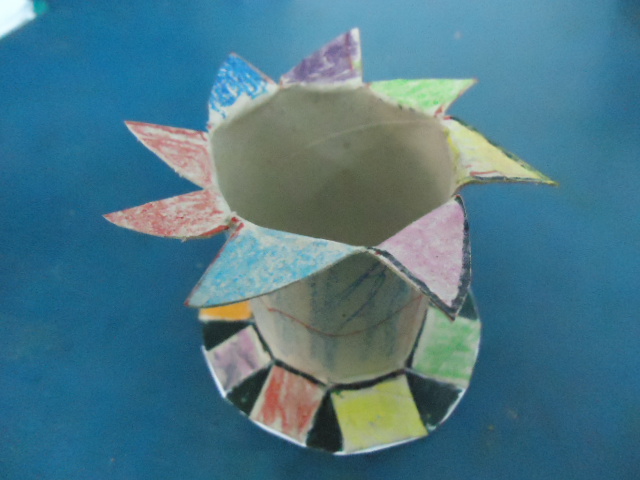
Easy toilet paper roll pencil holder crafts with kids

I was inspired by the crafts idea at 'Khadija's creative mind' and planned to do toilet paper roll crafts for my nursery class.

Today I could finish making a cute pencil holder. As I had to give this projects individually to all children of nursery class, I asked them to bring at least one toilet paper roll from home. It took about a week to collect toilet paper tubes. The first step was to cut slits on paper tubes and teachers have to do it as our kids are small to handle a bit hard stuff of toilet paper tube.


For next step I used a square sheet of white art paper for the base of pencil holder. Slit ends of tube were folded and fixed at square base.

We teachers of nursery class prepared it before kid's work. Kids were happy to see the raw form of pencil holder. They colored it and happily took home.
I have added two feet with this pencil holder.

With two feets I have trimmed the upper folded parts into circle petals.

Upper edges of paper tube can be trimmed into any shape.
As you can see I have shaped the finished product into more interesting work of crafts. What more you can do with it?
Pasting sequences, buttons and glitter can make it prettier and shows your creative skills when placing at your reading table and may be you can give it to your friend as a gift.
Note: I have taken all the pictures with my digital camera, keeping resolution a bit low as I have to edit pictures later for posting to blog. I will put my blog address or name at these pictures later but I hope that these pictures are not adopted at any other place without my permission. 

Monday, March 5, 2012

Play and Skill development among children

Play has always been part of learning and growing, and at the same time it provides enjoyment and fun. It is a tool which teachers or parents can use effectively for skill development among children. Play helps children develop intellectually,emotionally. It also helps in motor skills, and language development skills.

Kids need opportunities to play both alone and with other children. This will ensure that motor skills, cognitive skills and social skills all have a chance to develop and flourish.  Play is one of the ways children learn about and practice living in their world and their culture. It also helps children to manage their feelings and to cope with upsetting things that happen in their lives. Play helps build relationships.
Physical activities improve motor skills. Toys and activities that encourage them to use their imaginations can help them develop cognitive skills. And group activities enhance social skills.

List of various kind of plays and how they help in skill development among children.

Intellectual development (learning)
  • Sorting toys - learning about number and grouping 
  • Puzzles - learning about shapes, sizes, number 
  • Posting boxes - learning about space and size 
  • Hitting a mobile and making it move - learning about cause and effect 
  • Card games and board games 
  • Making up games
Developing motor (physical) skills                         
  • Pushing and pulling toys 
  • Riding on toys 
  • Picking up small things 
  • Throwing and catching 
  • Climbing toys 
  • Using crayons or paint brushes 
  • Writing Computer games 
  • Hitting balls
Social/emotional development
  • Playing alongside others and watching them 
  • Playing with others 
  • Playing mothers and fathers 
  • Copying adults and practising adult tasks and roles 
  • Water, paint and mud - expresses feelings Music - relaxes and expresses feelings 
  • Pretend play - dressing up Games with rules (eg hopscotch, card games, ball games)
Developing language
  • Stories and books 
  • Songs 
  • Nursery rhymes 
  • Games with friends and adults 
  • Talking to each other 
  • Listening to tapes
Cognitive Development

Many educational toys concentrate on cognitive development. This includes things like remembering, problem solving and decision making. These skills are essential for success in school and all other aspects of life. Any activity that requires imagination has the potential to encourage problem solving and decision making skills. Games such as Memory and Bop can help a child develop his memory.

An important part of play for young children is play with parents, and there should be some time for this every day. A toy company some years ago asked a large number of five year olds what they would like for Christmas, and their survey found that many children wanted more time with their parents!
Source:
http://www.cyh.com/

More useful links and online sites:


* The Role of Pretend Play in Children's Cognitive Development 

* How to accelerate fine motor skill development among children?

Sunday, March 4, 2012

Blow painting -A fun art activity for early year kids

Research shows that arts and crafts help kids to develop brain capacity in early childhood. Participating in arts and crafts also encourages self confidence, concentration and positive social skills such as flexibility and cooperation.

What you need to start this activity?

  • Art paper or simple A4 size white sheet of paper,
  • poster or water colors (keep cup or container for each color)
  • straw and dropper.

Poster or water color should be mixed with water. With the help of dropper or paint brush you just put few drops of water color or poster color at paper and blow the straw in different directions.
By turning the paper round, the paint can be blown more easily in different directions.

Children love blowing through straw and watch run colors in various directions. Kids of nursery class are amazed when they watch the formation of colorful pattern and design.
Finishing touch: Just cut long strips of poster paper with zig zag scissors and paste around the paper.

The facing picture shows a finished sample of 'blow painting'
There are many ideas which can make this blow painting process more creative as shown in two pictures at the end of the post.

Useful links:


* Blow painting at 'things to make and do'

Another idea from a site
Adding gooly eyes makes it 'germ blow painting'

Saturday, February 25, 2012

How to know if your child has handwriting problems? and what are the signs of handwriting problems?

Handwriting is one of the most important skills that children acquire and use throughout the school years as part of their occupation as students. When handwriting skills are deficient, children suffer various consequences related to their academic performance and social interactions, thus limiting their successful participation in everyday school activities


Parents and teachers need to analysis and check the signs of handwriting problems. Effects of poor handwriting or spelling in later years may be:                  
  • Papers with poorer penmanship and/or poorer spelling are rated lower by teachers for composition quality 
  • Difficulties with spelling or handwriting can interfere with execution of other composing processes
  • Handwriting/spelling problems can constrain development as a writer 
 Educational guidelines often are limited to one standard, “produces legible handwriting” in the English/language arts standards. When students fail to meet this standard, teachers have no means for examining which skills are lacking. Meanwhile these students are experiencing all the negative effects of poor handwriting.
Parents and teachers should learn the signs of handwriting problems from early years. 


Signs of Handwriting Problems 
Kids develop at different rates, and just like adults, handwriting varies greatly among them. Some kids have trouble learning the direction letters go in; others struggle to write neatly or use cursive writing. Sometimes writing problems can be a sign of other issues such as developmental delay or learning disabilities. Often these problems have multiple symptoms, with writing being only one component.


Conditions that can affect a child's ability to write include:              
• memory problems that prevent a child from remembering spelling, grammar, or punctuation rules
• language problems that cause difficulty with word pronunciation, spelling, and sentence structure
• visual or sequential ordering problems that cause uneven spacing of words, and inability to make lists or put ideas in order
• dysgraphia, a neurological disorder characterized by writing difficulties (such as distorted letters or misspellings) regardless of reading ability
• attention deficit hyperactivity disorder (ADHD)

Children who have special needs also may have trouble learning to write.

Signs that a child may need additional assistance with learning how to write include:
• A very awkward pencil grip
• Illegible handwriting • difficulty forming letters
• An inability to concentrate and complete writing tasks
• Avoiding writing • many misspelled words
• Letters or words that don't follow correct sequence
• Incorrect placement of words on the page
• Uneven spacing between letters
• A large gap between spoken language and writing ability
• An exceptionally slow and difficult time writing

If your child is struggling with writing, you may choose to have him or her assessed by an occupational therapist. This can help you determine if your child needs actual therapy and tutoring or just some additional writing practice at home. 


Related: 'Kidshealth.org'

Useful links:

Friday, February 24, 2012

Tips for teachers to help develop good handwriting

Handwriting is important because kids are required to use it daily in school from kindergarten on. Children who struggle with the mechanics of handwriting may have trouble taking notes or tests or completing their schoolwork. This can affect both their self-esteem and their attitude toward school.

By age 4, students should be starting to develop a tripod grasp which is using the thumb and index finger to hold the pencil/crayon and resting it on the middle finger. It is ok if the student rests the crayon/pencil on the 4th finger. If the student is still using a full hand grasp or very awkward grasp, this may indicate some difficulty with strength and coordination.                        

By age 4-5 students should be able to make vertical and horizontal lines, circle, square, triangle and draw a simple person with head, torso, legs, arms, hands, and feet. For the older students (1st grade and up), general neatness, staying on the lines, size consistency and spacing are all aspects to look at in determining if your child is struggling.

If your child's handwriting continues to be messy and hard to read even after formal instruction at school, try these tips: 


Help your child take it slow. Many kids struggle with writing because they try to do it quickly. Encourage your child to take time to form the letters carefully.

Explain that mistakes happen. Teach your child how to use an eraser.
Reinforce proper letter formation. Find out from your child's teacher how he or she should be forming letters, and then encourage your child to practice writing using those patterns. Using lined paper can be helpful.
Make sure the pencil is properly positioned. Ideally your child will use what is called a tripod grasp. This means the pencil should rest near the base of the thumb, held in place with the thumb, index, and middle fingers. Plastic pencil grips sold at office supply stores may help if your child has trouble holding a pencil properly.
Expose your child to lots of words. You can do this by reading regularly together, pointing out words that surround you (such as street signs or product labels), and by hanging up examples of your child's writing around the house.

Tips provided by 'Kids Health.org'

Useful links: 

Wednesday, February 22, 2012

Activities to promote a good foundation for handwriting among kids

Good foundation of handwriting starts at home. Proper fine motor skill development makes it possible for kids to learn good handwriting at school. Teachers at the same time can help kids enhance their skills needed  for good handwriting start. This post helps you learn about the activities which can help promote a good foundation for handwriting among kids.
Writing is one of the most complex tasks that humans engage in, involving both motor and critical-thinking skills. It's not surprising that learning to write is a process that takes years to complete. It also happens in order, with each skill building on the last.

Today modern technology has dramatically changed the way we communicate through writing. However, despite the increased use of computers for writing, the skill of handwriting remains important in education, employment and in everyday life. Handwriting with pen and paper still has an important role from early childhood through our adult lives.

Handwriting readiness can be developed by activities to improve children's fine motor control and isolated finger movements.

Activities to promote handwriting readiness: 
  • Rolling therapy-putty or clay dough between the tip of the thumb and tips of the index and middle fingers. Use modeling clay or Play-Doh to form words. First, make large flashcards with letters of the alphabet or simple words. (Laminate the cards if you can.) Then roll out thin ropes of clay. Ask your child to trace the words or letters on the cards using the ropes of clay. Not only will he learn to recognize words, but playing with the clay will help build the muscles in his fingers and hone the fine motor skills he'll need to write.                                              
  • Use sand to "write" words. Help your child make letters and words out of materials like sand, glitter, or cake sprinkles. Cookie dough and pancake batter work too — and you get to eat the results!
  • Picking up small objects with tweezers.
  • Pinching and sealing a zip lock bag using the thumb opposing each finger while maintaining an open web space.
  • Twisting open a small tube of tooth paste with the thumb, index and middle fingers while holding the tube with the ulnar digits.
  • Moving a key from the palm to the finger tips of one hand.
Activities to promote prewriting skills:
  1. Drawing lines and copying shapes using shaving cream, sand trays or finger paints.
  2. Drawing lines and shapes to complete a picture story on chalk boards.
  3. Drawing pictures of people, houses, trees, cars or animals with visual and verbal cues from the practitioner
  4. Completing simple dot-to-dot pictures and mazes.
Activities to enhance right-left discrimination includes
  1. Playing/maneuvering through obstacles and focusing on the concept of twining right or left
  2. Connecting dots at the chalkboard with left to right strokes.
Activities to Improve children's orientation to printed language:
  1. Labeling children's drawings based on the child's description
  2. Having children make their own books on specific topics such as favorite foods, special places etc.
  3. Labeling common objects in the therapy room.
  4. Look at pictures together in magazines, catalogs, or storybooks. Ask your child to tell you what he thinks the people are doing or thinking, and write down what he says as a caption. Or ask him to narrate a conversation he thinks two people may be having.

Tuesday, February 21, 2012

Prophet stories for kids- Prophet Nuh (alayhis salam)

Muslims identify the Prophets of Islam as those humans chosen by Allah (God) and given revelation to deliver to mankind. We muslims believe that every prophet was given a belief to worship God and their respective followers believed it as well.
Each prophet  preached the same main belief of worshiping Allah and in the avoidance of idolatry and sin. Prophet Noah or Nuh (alayhis salam) was among one of those prophets. It is a true, interesting and moral story to tell the kids about a prophet who created a big boat. When I tell this story to kids and after few days I ask 'Can you tell me the name of prophet who made a big boat?' and they quickly answer me 'Prophet Nuh (AS)


Prophet Nuh (alayhis salam)

Nuh (alayhis salam) lived many years after Adam (alayhis salam). The people with whom Nuh (alayhis salam) lived refused to listen to him. When he said that they should worship only Allah (Ta'ala) and do good, they paid no attention.

Nuh (alayhis salam) told them they would be severely punished for ignoring him and the message he brought from Allah. Even so, the people did not believe what Nuh (alayhis salam) told them.

They laughed at him and said, "You are only a man like us. Only poor, weak people believe you. If you are telling truth, then show us the punishment you threaten. You are nothing but a liar!"
"I do not want anything from you," Nuh (alayhis salam) answered, "and I shall never send away the poor or the weak. As far as the punishment is concerned, Allah will bring it upon you whenever he pleases. Dont imagine you can stop Allahs plans!"
Nuh (alayhis salam) was both sad and angry that people would not heed his message. But Allah informed Nuh (alayhis salam) that he should not feel this way. There was much more important work to do. Nuh (alayhis salam) must build a big ship.
Prophet Nuh (alayhis salam) was commanded to build a big ship/Ark, In obedience to Allahs instructions, Nuh (alayhis salam) began to build the ship on land. The people who saw it when they were passing made fun of him and his ship.

But Nuh (alayhis salam) had a warning for them. "You are making fun of us now," he said, "but soon we will know who has to suffer the severe punishment!" When the ship was completed, it started to rain without ceasing and the waters on earth began to rise. Allah (subhanahu wa Ta'ala) told Nuh (alayhis salam) to go into the ship, together with his family and all his friends who believed. Nuh(alayhis salam) should also take one male and female from each kind of animal on earth.

Nuh (alayhis salam) did as he was told and then he said, "In the name of Allah, we shall now sail away, and when the time is right, we shall return again to the land."

It is said that the flooding lasted one hundred and fifty days. When the waters receded, the ark came to rest over Mount Ararat. The occupants of the ark came out and thanked the Lord for their miraculous survival. They then spread out to inhabit the Earth again with the blessings of their Lord.

You can read about Nuh (Alayhis Salam) in the Qur’an, Sura 7,Ayat 59-64; Sura 11,Ayat 25-49; Sura 26,Ayat 105-122; Sura 54,Ayat 9-15; and Sura 71,Ayat 1-28.

Related and Useful links:

* Prophet Noah's boat

Activities to do at home to enhance writing skills


Parents can help their child develop good writing skills at home. Sports, games, and everyday activities help children improve many of the skills involved in handwriting. Activities like cutting, cooking, baking or crafting are helpful in development of hand eye-coordination skill. The more opportunities your child has to develop large and small movement in their arms, hands and fingers, the better.

Educational technology advances suggest that reading and writing development are intertwined in early learning. The relationship between reading and writing continues long after these early efforts, so parents can enhance their child's skills dramatically by encouraging the writing habit in childhood.

Few activities to do at home to enhance writing skills:

You can help your child by: doing activities like
  • Digging,
  • ‘Painting’ outdoor surfaces with water and a large brush,
  • Sweeping and swishing a scarf through the air in different shapes hanging out the washing,
  • Use a peg board and picking up grains of rice with fingers (which helps develop the grip needed for writing)
  • Make marks on paper with fingers, brushes and crayons              
  • Write labels, birthday cards and invitations
  • Rolling playdough and doing fingerplays help children strengthen and improve the coordination of the small muscles in their hands and fingers. They use these muscles to control writing tools such as crayons, markers, and brushes.
To improve visual memory, teach card games, marbles and jacks, and engage in hand sports- using large then smaller balls. Use dictation or a computer for homework assignments when a child's poor muscle strength and low endurance cannot sustain written work despite high intelligence. Encourage letter writing to family and friends.
Parents can engage their children in fun, practical activities that improve writing skills.

Some suggestions from Roy Peter Clark's book, "Free to Write":

Interviews. Encourage children to ask family members about life experiences, take notes and write short articles or stories based on what they learn. This can be especially fun if they ask a grandparent about a historical anniversary or an activity that is no longer common, like listening to radio shows.
Journals. Buy your child a special notebook to write in. Encourage him to write about daily activities, important life events, feelings and other personal topics.
Television. Turn watching television into an educational activity by asking children to write about a program they've seen. They can retell the show's story, or better yet, explore the values and meanings it expressed. Reading. Read aloud to your children. This will improve their writing by exposing them to well-written sentences and well-expressed ideas.
Proud displays. Have a place in your home where you display your children's writing. This will build their confidence and encourage them to write more often.
Dictation. Encouraging very young children to generate ideas and think in complete sentences. This will help prepare them to write alone when they get older. Encourage children to dictate stories and ideas to you, and keep them so they can read them later.


Useful links:

Helping Children Develop Fine Motor Skills

* Adventures in writing-how you can help her develop this new skill with confidence.

* Help Your Child Learn Writing Skills

Saturday, February 18, 2012

Skill development -Importance of proper pencil grip among children

Teaching a child how to correctly hold a pencil is a basic foundational skill. Proper pencil grip helps good handwriting in later years. Children usually begin their grip development around the age of 1 to 1½. So teaching them proper pencil grip should start from early years.

Good habits that begin in early years will last a lifetime—and holding a crayon or pencil correctly is a very important habit. Awkward grips can cause fatigue, cramping, and even pain—making writing difficult. Pencil grip difficulties become more apparent in primary years as writing demands increase, however, they can develop in children as early as preschoolers.

The correct pencil grip involves holding the pencil between the thumb and pointer finger, and resting the pencil on the middle finger for added stability. Since a child’s natural inclination is to hold a pencil with his entire fist (pinky finger closest to the paper and index finger and thumb on top), the proper pencil grip must be actively taught. Since writing comfortably is a skill your child will use throughout his lifetime, it is wise to help your child develop a comfortable and efficient pencil grip when he is young. Also, it is much easier to learn to hold a pencil correctly at the start than it is to unlearn an improper pencil grip and retrain muscles to learn the proper grip once your child is older.


Related Posts Plugin for WordPress, Blogger...